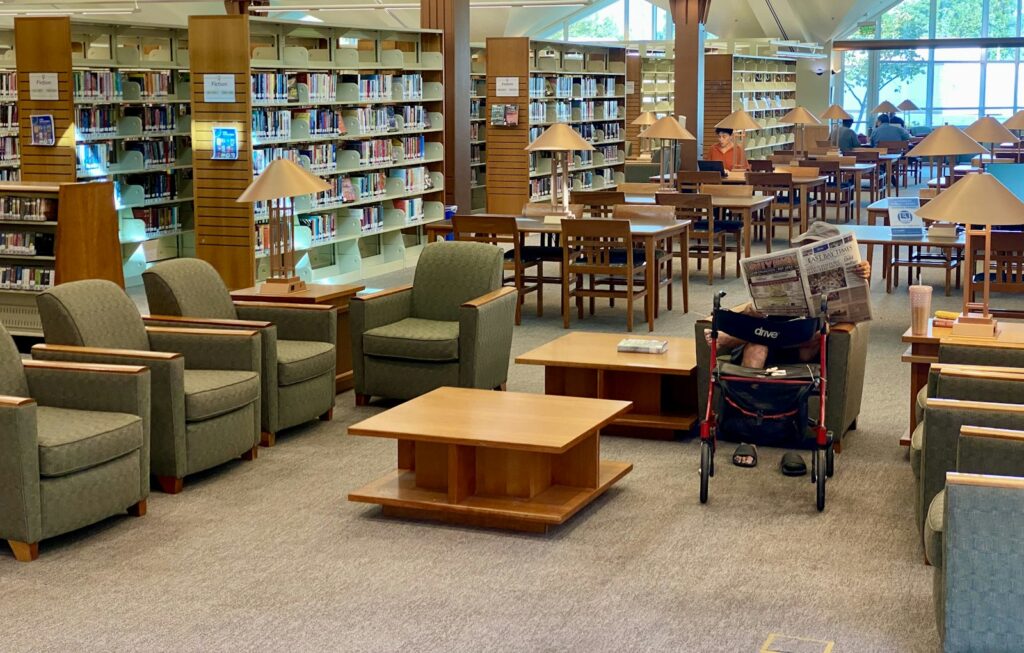
A study room is a different proposition from a study spot. You are not looking for a corner of a coffee shop and a tolerant barista; you want a door that closes, a table you can spread out on, and a whiteboard you can argue in front of. San Antonio has more of these than most cities its size, spread across a public library system, a county digital library experiment, three university campuses and a community college with one of the largest concentrations of bookable group rooms in the city.
The catch is that almost none of them work the same way. Some take reservations seven days out. Some refuse reservations entirely. Some belong to students only. This guide sorts them by how you actually get in.
Central Library: three rooms on the first floor, booked by phone or by arriving early
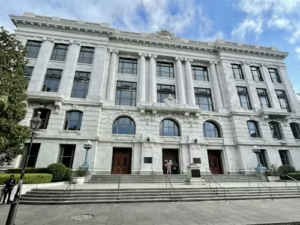
The Central Library at 600 Soledad, the downtown flagship of the San Antonio Public Library, holds its study rooms inside the Latino Collection and Resource Center on the first floor. There are three of them, and each takes one person or a group of up to four.
Access runs two ways. You can walk up to the first-floor Reference desk and ask, in which case rooms go to whoever gets there first. Or you can book ahead by calling Information Services on (210) 207-2500 with your name, the date and time you want, your group size and your contact details — requests have to land at least 48 hours before the start time. Sessions run in two-hour blocks, extendable if nobody is waiting, and each person gets one session per day. Rooms must be vacated ten minutes before the library closes.
That 48-hour window is the detail that catches people out. If you decide on Tuesday night that you need a room on Wednesday morning, the phone route is closed to you and you are back to arriving early. The LCRC itself is worth knowing about beyond the rooms: a bilingual collection of more than 14,000 volumes, the Ramiro S. Salazar Art Gallery, and the Ana Paula and Mark Watson Writing Room share the same floor, so the ambient noise level is closer to a reading room than a lobby.
San Antonio College: eighteen rooms, no reservations, first come first served
For sheer volume of group space the San Antonio College Library in the Moody Learning Center is hard to beat. It runs eighteen group work rooms across the second, third and fourth floors, in rooms MLC 200, MLC 308 and MLC 409.
Capacities vary by room, from four-to-six people up to eight-to-ten in the larger ones — MLC 200A, 200F, 308B and 409A are among the bigger spaces. Some rooms come with whiteboards and computers with internet access and printing.
Crucially, the library takes no bookings at all: the rooms are first come, first served, and no reservations are needed or accepted. For a group of six that decided twenty minutes ago to meet, this is the best arrangement in the city. For a group that wants certainty on Thursday at two, it is the worst. Eighteen rooms is a lot of capacity, though, and the odds of all of them being full at once are low outside finals.
UTSA: thirty-three rooms at John Peace, fifteen downtown, students only
UTSA Libraries operate the deepest inventory of study rooms in San Antonio. The John Peace Library has thirty-three: ten on the second floor (A2 through A11), twenty on the third (B1 through B20), and three fourth-floor Study Suite rooms (C1 to C3). The Downtown Library adds fifteen more, and the Applied Engineering and Technology Library has three. Rooms take groups of up to nine.
Booking is restricted to current UTSA students with a valid UTSA ID. Reservations run up to two hours at a time, two concurrent bookings per student, up to seven days ahead, and if nobody occupies the room within the first ten minutes of the start time the reservation is forfeited and the room opens to anyone. You can book online or at kiosks at John Peace, Downtown and AET. The rooms at those three libraries are unlocked, with no key to collect, and dry erase markers and erasers are already inside; HDMI cables and adapters come from the front desk against a UTSA card or photo ID.
The Student Union has nine more rooms — Wild Persimmon, Acacia, Magnolia, Buckeye, Redbud, Paloverde and Oak in Student Union North, plus Nueces and Cameron in the HEB Student Union. These are locked, so you call Student Union Events Management on 210-563-9798 to get one opened.
If you are not a UTSA student, you can still use the building
This is the part most people miss. The study rooms are students-only, but the libraries are not. UTSA’s policy states that any community member may use physical collections on site, and most electronic resources are available on guest computers there too.
So the rooms are out, but the quiet floors are in. John Peace has Quiet Study and Quiet Computing on the second floor, and on the third a Quiet Spot, a four-seat Quiet Computing Room, Quiet Zone study tables and a Graduate Quiet Study Room. GroupSpot, near the second-floor Information Desk, is the collaborative counterpart. The Downtown Library has an Atrium Quiet Area. For a solo session with a laptop and headphones, a quiet floor at a university library does the job a bookable room would — you simply cannot shut a door behind you.
BiblioTech: study rooms in a library with no books
Bexar County’s BiblioTech branches are all-digital public libraries, and each one has study rooms. BiblioTech South at 3505 Pleasanton Road, inside the Precinct 1 County Building, has two study rooms, a community room and 48 computers with specialized software, plus printing, faxing and scanning. It opens Monday 9am to 6pm, Tuesday to Friday noon to 8pm, Saturday 10am to 6pm and Sunday 10am to 6pm.
BiblioTech West at 2003 S. Zarzamora, on the corner of Zarzamora and Brady, has one study room and more than 40 computers. It keeps the same schedule: Monday 9am to 6pm, Tuesday to Friday noon to 8pm, Saturday and Sunday 10am to 6pm. The branch sits inside an apartment complex, with parking round the back.
BiblioTech East at 1203 N. Walters, at the corner of Walters and Burnet, has two study rooms, a community room and over 50 public computers. It is also inside an apartment complex, and open to the public.
Those weekday noon-to-eight hours are the useful thing here. Most public library branches in Texas close at six; a room you can use until eight on a Tuesday is genuinely scarce.
The two campuses with the strictest and the loosest doors
The Briscoe Library at UT Health Science Center San Antonio reserves its group study rooms for people attached to the Health Science Center, with bookings through the library’s own online reservation system. The public is not eligible, so if you have no connection to UT Health, treat Briscoe as closed to you for room purposes and go elsewhere.
At the other end, the Texas A&M University-San Antonio library takes study room bookings through an online calendar, and its rooms cover both quiet individual work and group collaboration. One practical warning from the library itself: the doors lock fifteen minutes before posted closing time each day. Plan your exit, not just your arrival.
How to choose, in one pass
If you need a guaranteed room at a specific hour and you are a UTSA student, book John Peace or Downtown up to a week out. If you are a UTSA student who needs a room in the next thirty minutes, walk into John Peace anyway — thirty-three rooms with a ten-minute no-show forfeit means turnover is constant.
If you are not a student and you need a door that closes, your options are the three LCRC rooms at Central or a BiblioTech branch. Call Central two days ahead if you can; otherwise BiblioTech South and East each have two rooms and far less foot traffic than a downtown central library.
If you are a group of six or more with no notice, the Moody Learning Center at San Antonio College is the answer, precisely because it will not let you book.
And if what you actually want is a quiet table rather than a private room, the quiet floors at John Peace are open to any community member, and the city’s cafes cover the rest. We have separate guides to quiet cafes and study spots in San Antonio, to late-night study spots for sessions that run past library hours, and a general round-up of places to study in San Antonio.
Frequently Asked Questions
Where is the best place to study in San Antonio?
It depends on whether you need a closed door. For a private room, Central Library’s Latino Collection and Resource Center and the BiblioTech branches are the two routes open to everyone, and UTSA students have thirty-three rooms at John Peace alone. For an open table with quiet around it, the second and third floors of John Peace are open to community members, and the Moody Learning Center at San Antonio College has eighteen group rooms you cannot reserve but can usually walk into.
Which San Antonio libraries offer study rooms?
Central Library has three, inside the Latino Collection and Resource Center on the first floor. BiblioTech South and BiblioTech East each have two; BiblioTech West has one. On the academic side, UTSA’s John Peace Library has thirty-three, its Downtown Library fifteen and its AET Library three, all restricted to UTSA students. San Antonio College’s Moody Learning Center has eighteen group work rooms, and the Briscoe Library at UT Health Science Center has rooms limited to its own students and staff.
Where can I find free meeting rooms in San Antonio?
Every room listed in this guide is free to use — the constraint is eligibility and timing, not price. BiblioTech South and BiblioTech East both have a community room in addition to their study rooms. Central Library’s three LCRC rooms take groups of up to four and cost nothing, whether you book them by phone or claim one at the Reference desk.
Can I book a study room for the same day?
Sometimes. Central Library needs 48 hours’ notice for a phone booking, but walk-up requests at the first-floor Reference desk are same-day by definition. UTSA students can book up to seven days ahead and also right now if a room is free. San Antonio College does not accept bookings at all, so every room there is same-day. The one thing you cannot do is reserve a Central Library room on the morning you want it.